Skip to content

Flagship product

A real estate agency, running on one system

EMS manages properties, leases, receivables, deposits, documents and tenant risk for a property business — in three currencies, with every change authorised and logged.

In production with a real estate agency in Türkiye. Available for acquisition, licensing or investment.

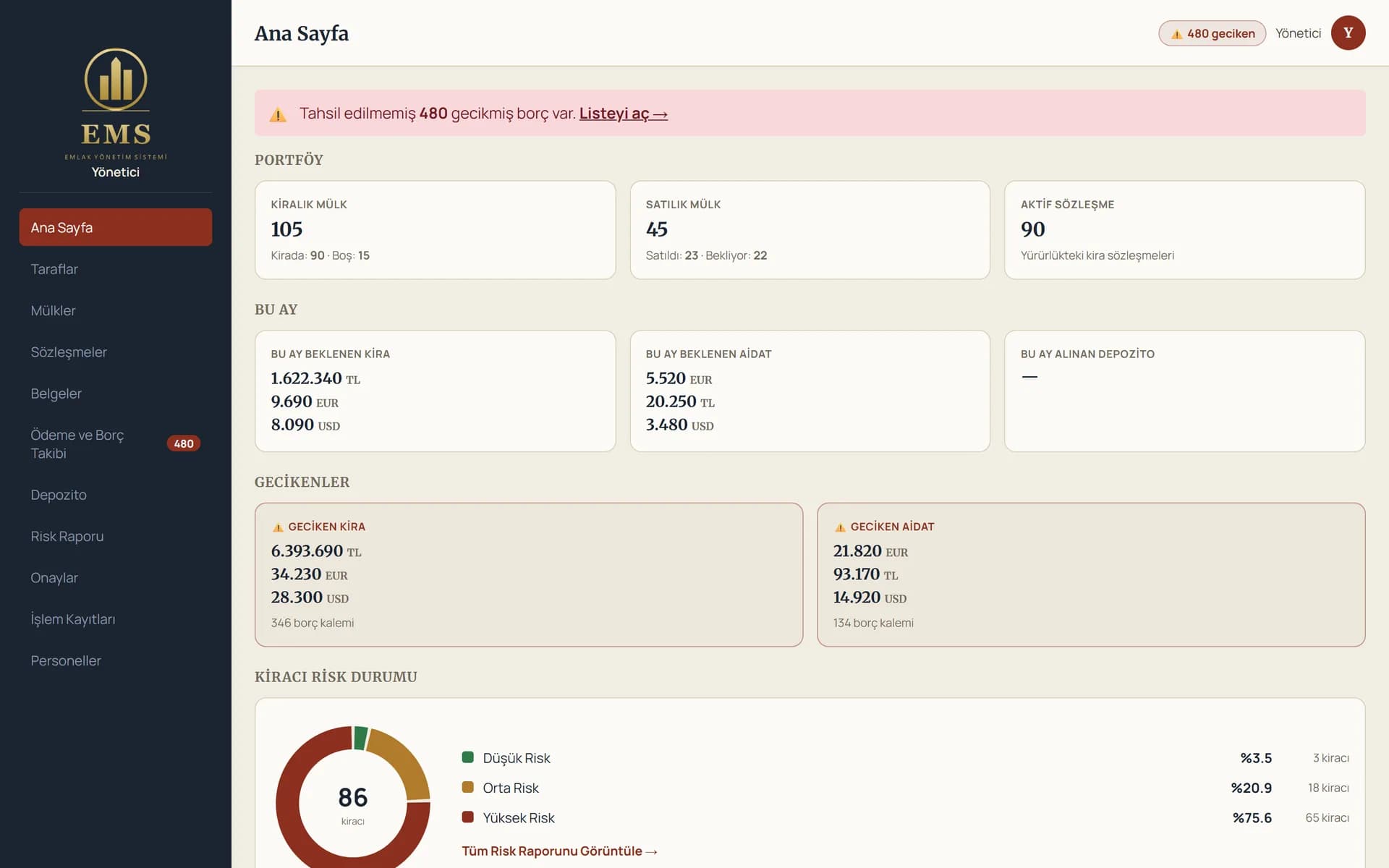
EMS — Dashboard
EMS dashboard showing portfolio counts, monthly expected rent per currency, overdue balances and the tenant risk distribution
20
Modules delivered
4
User roles
3
Currencies, never converted
35
Pages of user manual

The problem

A mid-sized agency runs on spreadsheets, a shared drive and the memory of whoever has been there longest. The work is not complicated — it is simply impossible to see all at once.

  1. Money arrives in three currencies

    Rent in lira, service charges in euro, a sale in dollars. Add them together and the number is fiction; keep them apart by hand and nobody knows where the month stands.

  2. Nobody remembers who paid late

    Payment history lives in bank statements and conversations. When a lease comes up for renewal, the decision is made on impression rather than record.

  3. Staff changes break everything

    Contracts, title deeds and receipts sit in folders named after people who have left. There is no trail of who changed what, or when.

Receivables

Every expected payment, in the currency it was agreed in

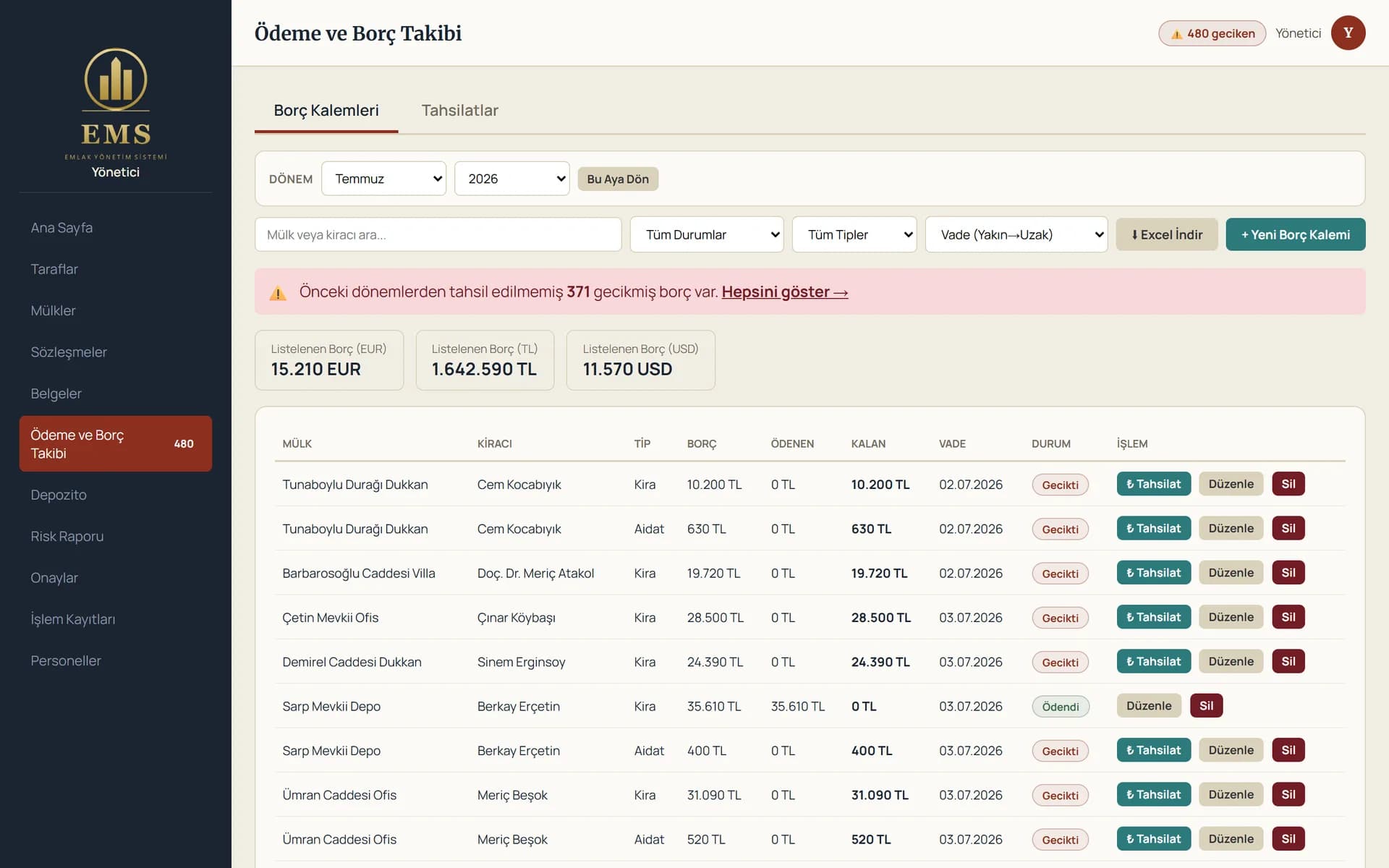
Saving a lease generates its debt items automatically. Collections are recorded against those items with the bank receipt attached, and each item's status is derived from what has actually been collected — never typed in by hand. Totals stay grouped by currency, because a converted total is a number nobody can defend.

  • Rent and service charges tracked as separate obligations
  • Per-field currency selection — rent in lira, service charge in euro, on the same lease
  • Partial payments supported; one obligation can take several collections
  • Status computed from collections: pending, partial, paid, overdue
EMS — Receivables
Payments and receivables screen listing debt items with due dates, amounts, remaining balances and status badges, with totals shown separately per currency

Documents

Contracts, deeds and receipts attached to the right record

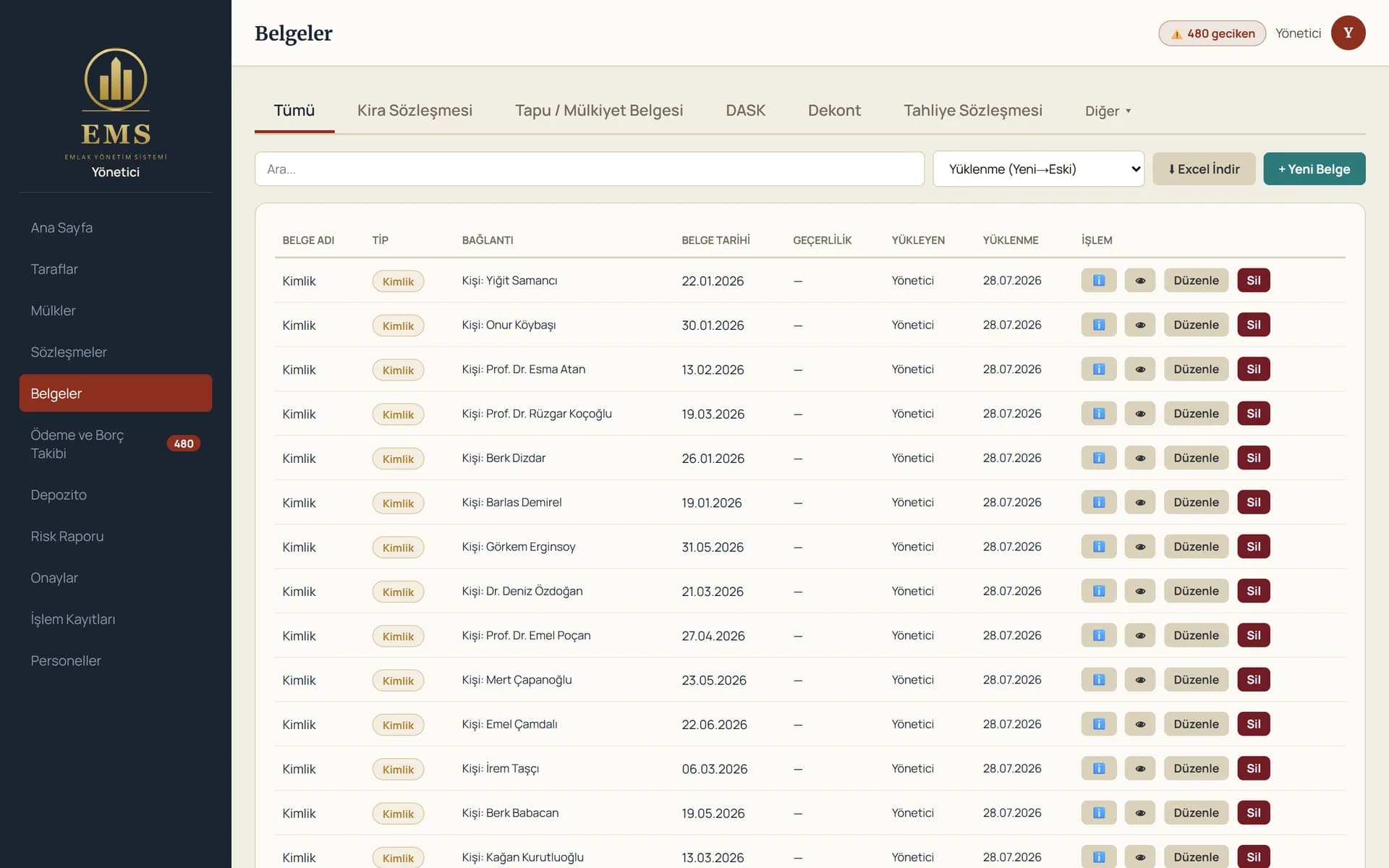
Ten document types, each bound to exactly one owner — a property, a person or a lease. Issue date and expiry date are tracked separately, so an insurance policy that lapses is visible before it matters. Uploading the contract is mandatory the moment a lease is created.

  • Lease, title deed, earthquake insurance, receipt, termination agreement
  • Plus identity, passport, addendum, energy certificate and other
  • Separate document date and validity date
  • Every file traceable to the record it belongs to
EMS — Documents
Documents screen listing uploaded files by type with the record each one is attached to

Also inside

The rest is a conversation

The remaining screens, the data model behind them and the codebase itself are covered in a live walkthrough we run with serious enquiries. It is the fastest way to judge whether this fits what you have in mind — and it is not something a set of screenshots can answer.

Ask for the walkthrough
  • Tenant risk scoring

    An automatic score from the payment ledger — lateness, partial payments, open items, with a three-day tolerance — blended 70/30 with a manual assessment from whoever deals with the tenant.

  • Two-step authorisation

    Every create, update and delete by a staff member becomes a request. The manager approves or rejects with a reason, and only then does the record move.

  • Leases and deposits

    Lease status stays synchronised with property occupancy; deposits are tracked from receipt through deduction to return, with the supporting document attached.

  • Full activity log

    Who changed what, and when, across every record type — with period filters and per-role visibility.

Self-service

The agency stops being the switchboard

Owners and tenants get their own logins. The questions that used to arrive by phone — what is outstanding, where is the contract, was the deposit returned — are answered by the system.

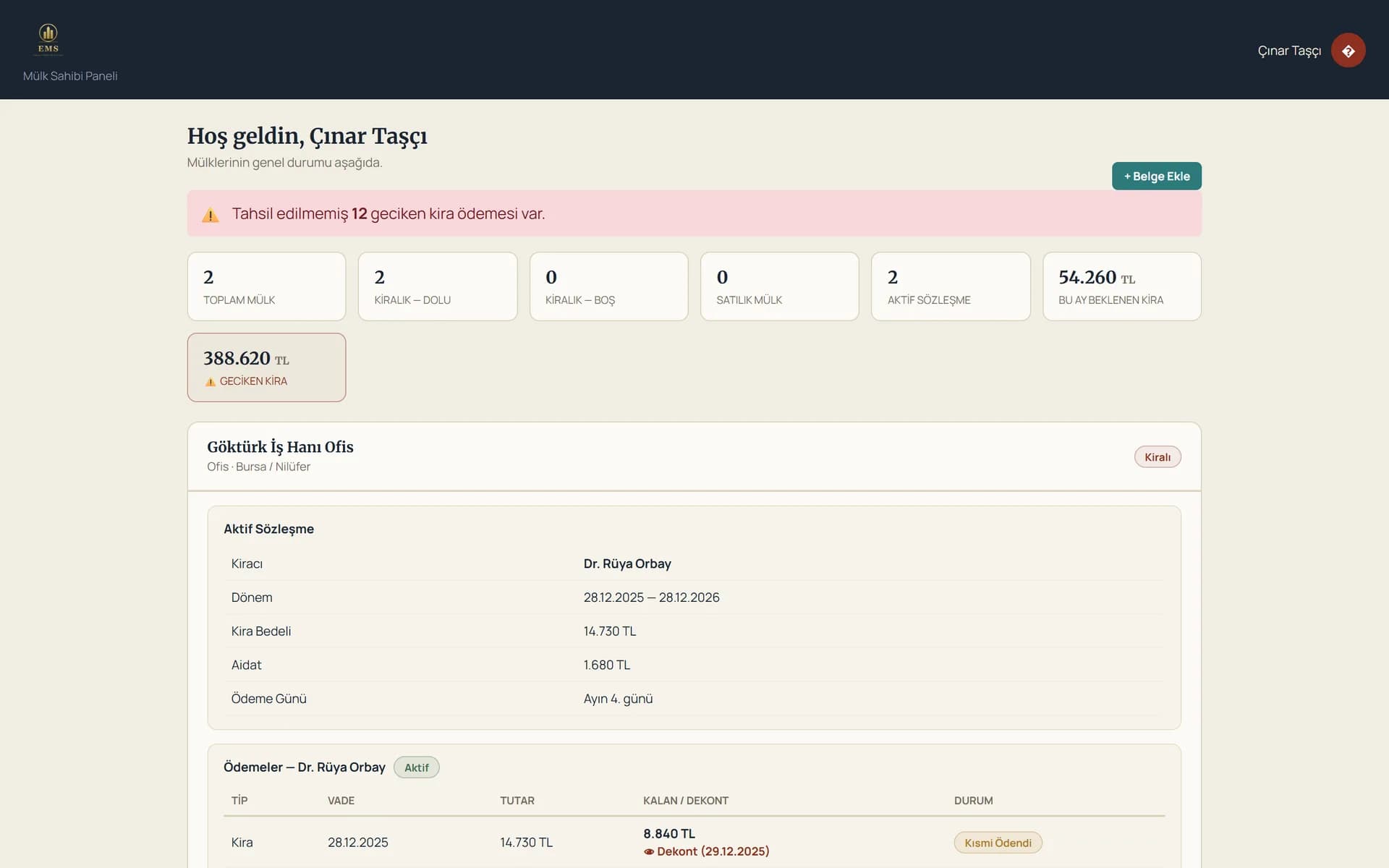
Property owners see their own portfolio
Owner portal showing portfolio summary cards and an expandable card per property with lease and payment detail

Property owners see their own portfolio

Each owner logs in to their properties, active and historic leases, the payment schedule with amounts still outstanding, deposit status and every document attached to their property.

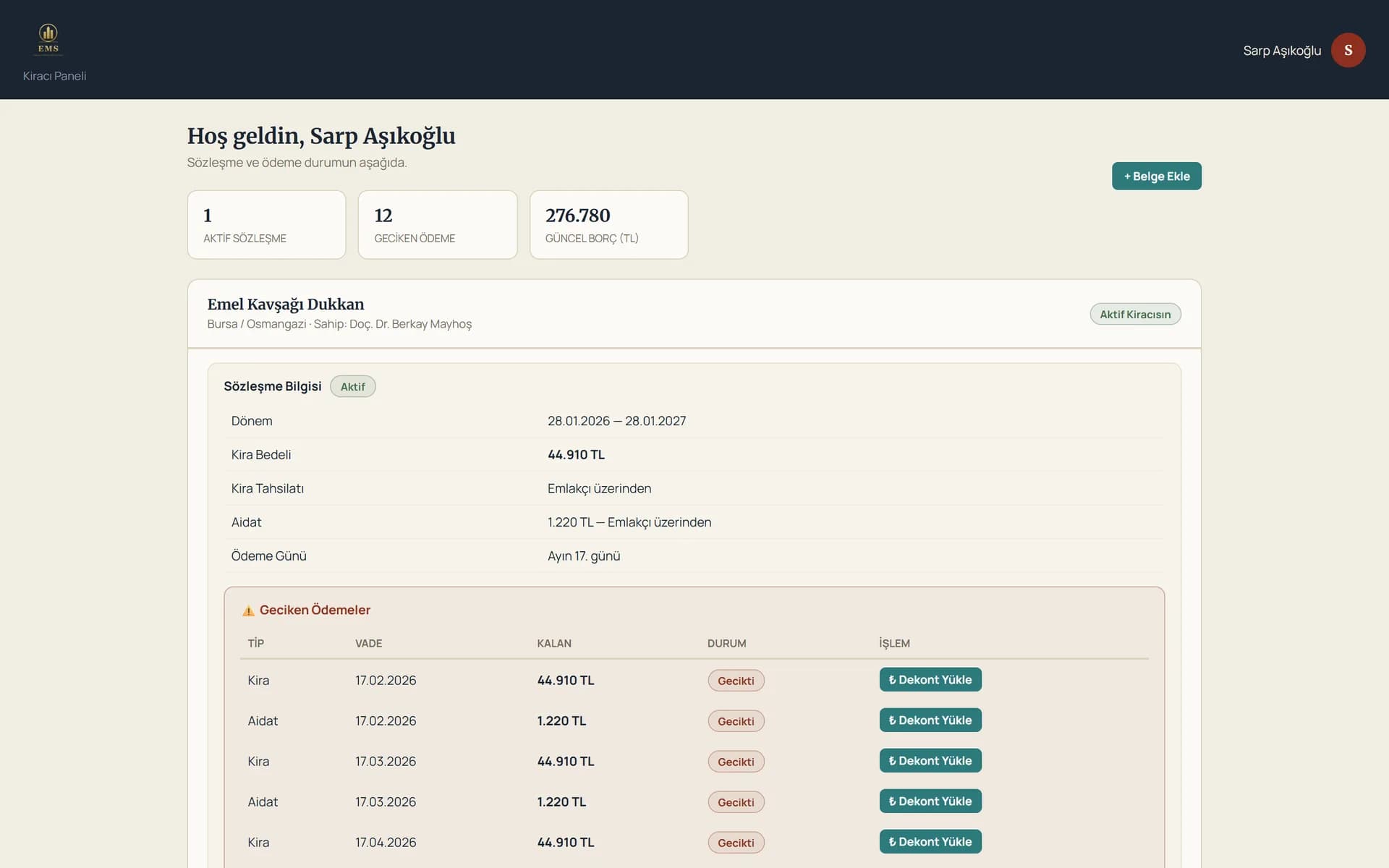
Tenants settle their own balance
Tenant portal showing the active lease, overdue payments and a receipt upload action for each item

Tenants settle their own balance

Tenants see this month's obligation and anything overdue before it, then upload the bank receipt themselves. The upload enters the approval queue; once the manager confirms it, the balance drops automatically.

Why it holds up

Four decisions that separate this from a generic property CRM

Currency isolation as a design decision

Most property systems convert everything to one currency and quietly lose the truth. This one refuses to, which is exactly what an owner holding leases in three currencies needs.

Authorisation built into the data layer

The approval queue is not a screen bolted on top; it sits between every staff write and the database, covering eight record types including uploads from owners and tenants.

Risk scoring that survives scrutiny

The automatic component is computed from the payment ledger, so the number can always be traced back to the items that produced it.

Built for how Turkish agencies actually work

Turkish-aware search that matches ç, ğ, ı, i, ö, ş and ü correctly, lira alongside foreign currency, and the document types the local market runs on.
Ways to take it on

Buy it, licence it, or build the SaaS with us

Outright acquisition

Full transfer of the source code and all rights to a single buyer, with a handover period.

  • Complete codebase and version history
  • Documentation, test data tooling and deployment notes
  • Transition support agreed per engagement

Licensing

Deploy the platform for your own agency under a commercial licence, with the option of continued development.

  • Single-agency deployment on your infrastructure
  • Configuration and data migration support
  • Ongoing maintenance available

White-label & SaaS

Resell it under your own brand, or run it as a subscription service for multiple agencies.

  • Branding replaced throughout the interface
  • Multi-tenant build restorable from version control
  • Partnership terms negotiated case by case

Where this goes next

The platform is finished as a single-agency product and proven in daily use. The obvious next step is the multi-tenant subscription build — the tenant isolation layer was never removed from the codebase, so that is a restoration rather than a rewrite. Scheduled email and SMS reminders are specified and not yet built. We are open to a buyer, a licensee, or an investor who wants to take it there with us.

Start the conversation

On the roadmap

  1. Restore the multi-tenant build and take it to subscription
  2. Scheduled email and SMS payment reminders
  3. English interface for markets beyond Türkiye

Client work

We solved our customers' problems

Before the flagship platform there were nine other systems, each built for one company and shaped around one operational problem — a clinic that needed to track coagulation results, a manufacturer that could not trace a batch, a sales team working from a spreadsheet.

They are the reason the real estate platform exists in the shape it does: it is what a decade of solving other people's operational problems turns into when you finally build one for yourself.

About us

Engineering the future of business

At Çözüm Ekseni we don't just write code; we engineer scalable, secure and user-centric ecosystems. From complex B2B infrastructures to interactive mobile environments, our full-stack capabilities turn operational bottlenecks into streamlined digital assets.

We work in small numbers and stay on a system after it ships, which is why the work below reads as measurements rather than adjectives.

How we work, measured

  • Query counts on the heaviest screens were measured and reduced — the dashboard from 3,479 queries to 26, the party list from 2,027 to 13.
  • List screens paginate at 25 rows while exports still return the full filtered set; summary totals are computed from the whole query, not the visible page.
  • Page weight was cut by rendering a single edit panel per screen instead of one per row — the documents screen dropped from 19.7 MB to 178 KB.
  • Public registration was removed and the tenant scope made fail-closed after a security review of the whole codebase.